
本文深入探讨了 Agentic AI 这一新兴领域,强调其超越传统 RAG 模型、推动实际业务影响的重要性。Agentic AI 通过使智能体能够推理、行动和协作来实现这一目标。文章介绍了构建强大企业自动化解决方案的五个基本模式:工具使用(智能体与系统交互)、反思(自我改进以提高可靠性)、规划(分解复杂任务)、多智能体(专业智能体之间的协作)和 ReAct(自适应问题解决)。每个模式都通过真实的 enterprise 示例进行了解释。文章强调,这些模式旨在结合使用,以获得更有效的解决方案。最后,文章提出了 Azure AI Foundry 作为一个重要的统一平台,旨在解决构建和扩展智能体的挑战,提供灵活的模型选择、模块化架构、企业系统集成、安全性以及全面的可观察性等功能。
This blog post is the first out of a six-part blog series called Agent Factory which will share best practices, design patterns, and tools to help guide you through adopting and building agentic AI.
Beyond knowledge: Why enterprises need agentic AI
Retrieval-augmented generation (RAG) marked a breakthrough for enterprise AI—helping teams surface insights and answer questions at unprecedented speed. For many, it was a launchpad: copilots and chatbots that streamlined support and reduced the time spent searching for information.
However, answers alone rarely drive real business impact. Most enterprise workflows demand action: submitting forms, updating records, or orchestrating multi-step processes across diverse systems. Traditional automation tools—scripts, Robotic Process Automation (RPA) bots, manual handoffs—often struggle with change and scale, leaving teams frustrated by gaps and inefficiencies.
This is where agentic AI emerges as a game-changer. Instead of simply delivering information, agents reason, act, and collaborate—bridging the gap between knowledge and outcomes and enabling a new era of enterprise automation.
Patterns of agentic AI: Building blocks for enterprise automation
While the shift from retrieval to real-world action often begins with agents that can use tools, enterprise needs don’t stop there. Reliable automation requires agents that reflect on their work, plan multi-step processes, collaborate across specialties, and adapt in real time—not just execute single calls.
The five patterns below are foundational building blocks seen in production today. They’re designed to be combined and together unlock transformative automation.
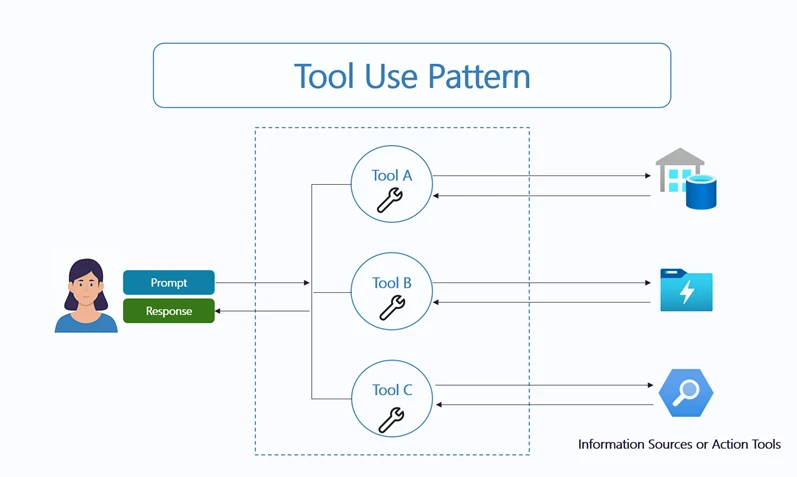
1. Tool use pattern—from advisor to operator
Modern agents stand out by driving real outcomes. Today’s agents interact directly with enterprise systems—retrieving data, calling Application Programming Interface (APIs), triggering workflows, and executing transactions. Agents now surface answers and also complete tasks, update records, and orchestrate workflows end-to-end.
Fujitsu transformed its sales proposal process using specialized agents for data analysis, market research, and document creation—each invoking specific APIs and tools. Instead of simply answering “what should we pitch,” agents built and assembled entire proposal packages, reducing production time by 67%.
2. Reflection pattern—self-improvement for reliability
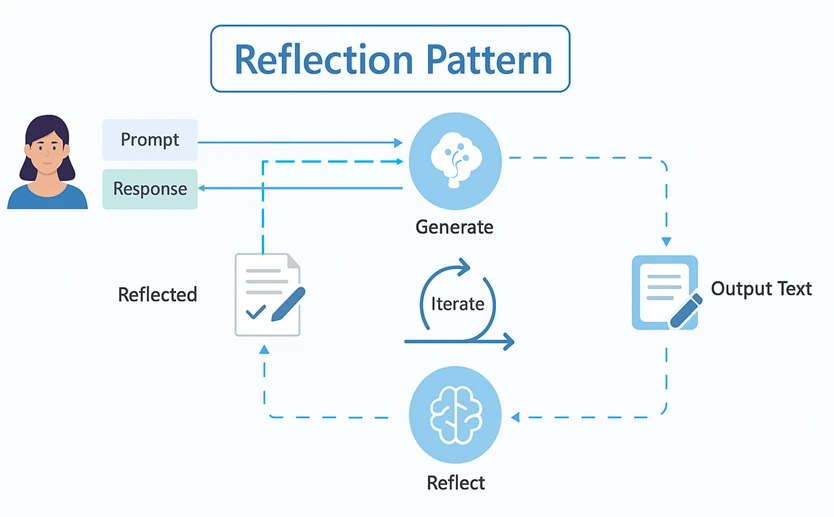
Once agents can act, the next step is reflection—the ability to assess and improve their own outputs. Reflection lets agents catch errors and iterate for quality without always depending on humans.
In high-stakes fields like compliance and finance, a single error can be costly. With self-checks and review loops, agents can auto-correct missing details, double-check calculations, or ensure messages meet standards. Even code assistants, like GitHub Copilot, rely on internal testing and refinement before sharing outputs. This self-improving loop reduces errors and gives enterprises confidence that AI-driven processes are safe, consistent, and auditable.
3. Planning pattern—decomposing complexity for robustness
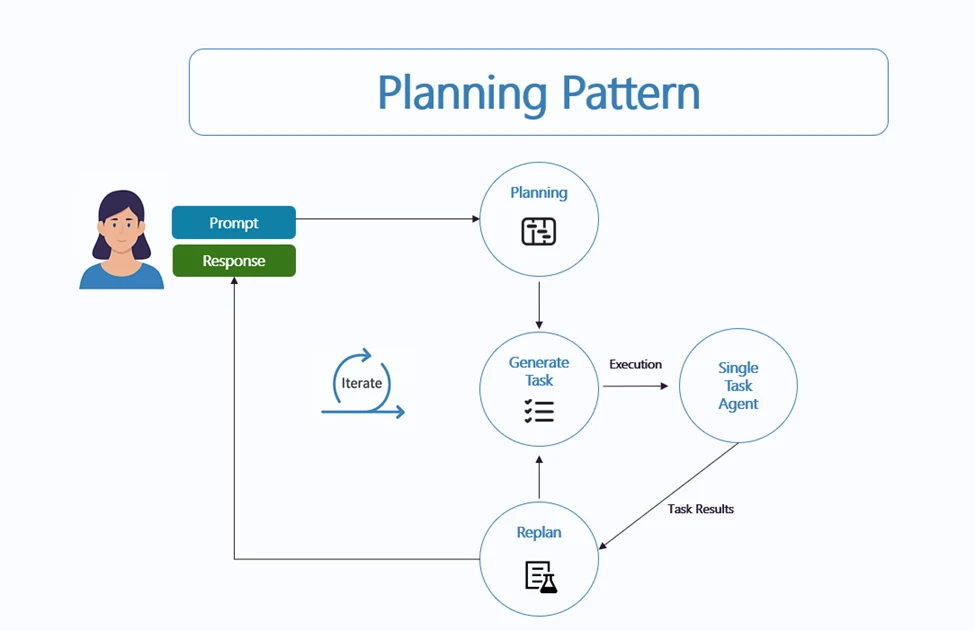
Most real business processes aren’t single steps—they’re complex journeys with dependencies and branching paths. Planning agents address this by breaking high-level goals into actionable tasks, tracking progress, and adapting as requirements shift.
ContraForce’s Agentic Security Delivery Platform (ASDP) automated its partner’s security service delivery with security service agents using planning agents that break down incidents into intake, impact assessment, playbook execution, and escalation. As each phase completes, the agent checks for next steps, ensuring nothing gets missed. The result: 80% of incident investigation and response is now automated and full incident investigation can be processed for less than $1 per incident.
Planning often combines tool use and reflection, showing how these patterns reinforce each other. A key strength is flexibility: plans can be generated dynamically by an LLM or follow a predefined sequence, whichever fits the need.
4. Multi-agent pattern—collaboration at machine speed
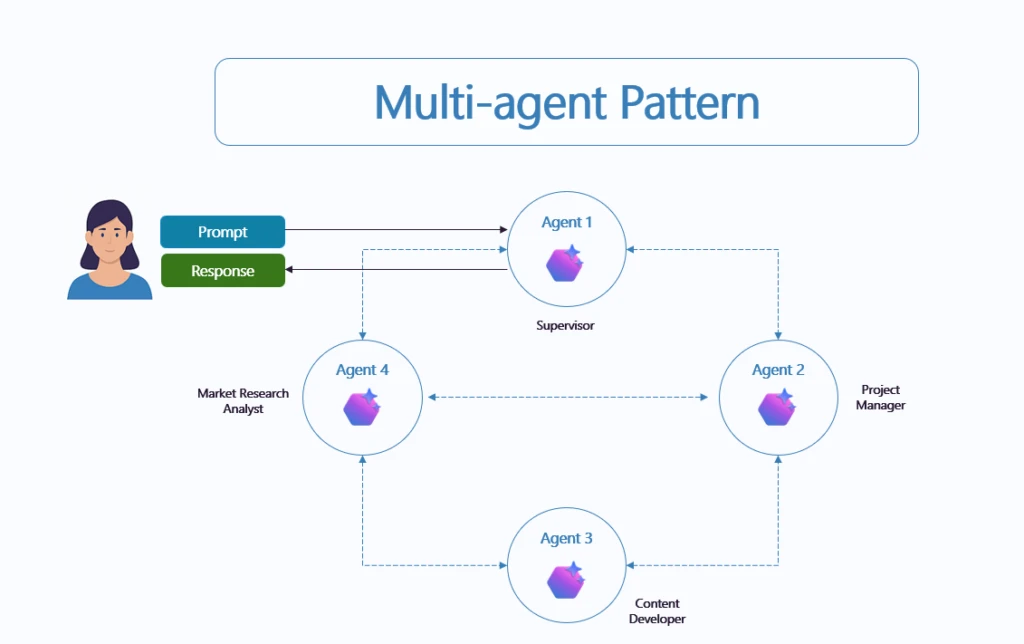
No single agent can do it all. Enterprises create value through teams of specialists, and the multi-agent pattern mirrors this by connecting networks of specialized agents—each focused on different workflow stages—under an orchestrator. This modular design enables agility, scalability, and easy evolution, while keeping responsibilities and governance clear.
Modern multi-agent solutions use several orchestration patterns—often in combination—to address real enterprise needs. These can be LLM-driven or deterministic: sequential orchestration (such as agents refine a document step by step), concurrent orchestration (agents run in parallel and merge results), group chat/maker-checker (agents debate and validate outputs together), dynamic handoff (real-time triage or routing), and magentic orchestration (a manager agent coordinates all subtasks until completion).
JM Family adopted this approach with business analyst/quality assurance (BAQA) Genie, deploying agents for requirements, story writing, coding, documentation, and Quality Assurance (QA). Coordinated by an orchestrator, their development cycles became standardized and automated—cutting requirements and test design from weeks to days and saving up to 60% of QA time.
5. ReAct (Reason + Act) pattern—adaptive problem solving in real time
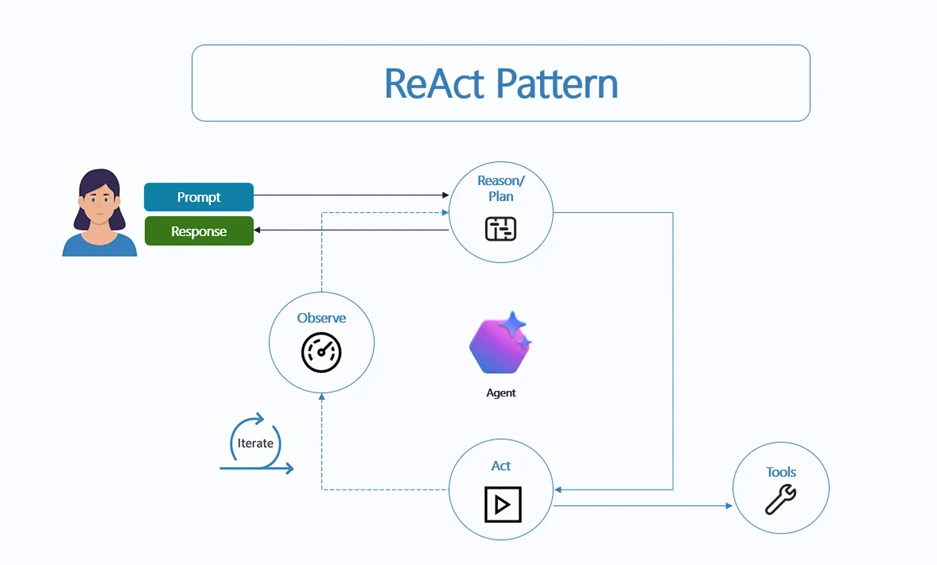
The ReAct pattern enables agents to solve problems in real time, especially when static plans fall short. Instead of a fixed script, ReAct agents alternate between reasoning and action—taking a step, observing results, and deciding what to do next. This allows agents to adapt to ambiguity, evolving requirements, and situations where the best path forward isn’t clear.
For example, in enterprise IT support, a virtual agent powered by the ReAct pattern can diagnose issues in real time: it asks clarifying questions, checks system logs, tests possible solutions, and adjusts its strategy as new information becomes available. If the issue grows more complex or falls outside its scope, the agent can escalate the case to a human specialist with a detailed summary of what’s been attempted.
These patterns are meant to be combined. The most effective agentic solutions weave together tool use, reflection, planning, multi-agent collaboration, and adaptive reasoning—enabling automation that is faster, smarter, safer, and ready for the real world.
Why a unified agent platform is essential
Building intelligent agents goes far beyond prompting a language model. When moving from demo to real-world use, teams quickly encounter challenges:
- How do I chain multiple steps together reliably?
- How do I give agents access to business data—securely and responsibly?
- How do I monitor, evaluate, and improve agent behavior?
- How do I ensure security and identity across different agent components?
- How do I scale from a single agent to a team of agents—or connect to others?
Many teams end up building custom scaffolding—DIY orchestrators, logging, tool managers, and access controls. This slows time-to-value, creates risks, and leads to fragile solutions.
This is where Azure AI Foundry comes in—not just as a set of tools, but as a cohesive platform designed to take agents from idea to enterprise-grade implementation.
Azure AI Foundry: Unified, scalable, and built for the real world
Azure AI Foundry is designed from the ground up for this new era of agentic automation. Azure AI Foundry delivers a single, end-to-end platform that meets the needs of both developers and enterprises, combining rapid innovation with robust, enterprise-grade controls.
With Azure AI Foundry, teams can:
- Prototype locally, deploy at scale: Develop and test agents locally, then seamlessly move to cloud runtime—no rewrites needed. Check out how to get started with Azure AI Foundry SDK.
- Flexible model choice: Choose from Azure OpenAI, xAI Grok, Mistral, Meta, and over 10,000 open-source models—all via a unified API. A Model Router and Leaderboard help select the optimal model, balancing performance, cost, and specialization. Check out the Azure AI Foundry Models catalog.
- Compose modular multi-agent architectures: Connect specialized agents and workflows, reusing patterns across teams. Check out how to use connected agents in Azure AI Foundry Agent Service.
- Integrate instantly with enterprise systems: Leverage over 1,400+ built-in connectors for SharePoint, Bing, SaaS, and business apps, with native security and policy support. Check out what are tools in Azure AI Foundry Agent Service.
- Enable openness and interoperability: Built-in support for open protocols like Agent-to-Agent (A2A) and Model Context Protocol (MCP) lets your agents work across clouds, platforms, and partner ecosystems. Check out how to connect to a Model Context Protocol Server Endpoint in Azure AI Foundry Agent Service.
- Enterprise-grade security: Every agent gets a managed Entra Agent ID, robust Role-based Access Control (RBAC), On Behalf Of authentication, and policy enforcement—ensuring only the right agents access the right resources. Check out how to use a virtual network with the Azure AI Foundry Agent Service.
- Comprehensive observability: Gain deep visibility with step-level tracing, automated evaluation, and Azure Monitor integration—supporting compliance and continuous improvement at scale. Check out how to monitor Azure AI Foundry Agent Service.
Azure AI Foundry isn’t just a toolkit—it’s the foundation for orchestrating secure, scalable, and intelligent agents across the modern enterprise.
It’s how organizations move from siloed automation to true, end-to-end business transformation.
Stay tuned: In upcoming posts in our Agent Factory blog series, we’ll show you how to bring these pillars to life—demonstrating how to build secure, orchestrated, and interoperable agents with Azure AI Foundry, from local development to enterprise deployment.